



In the UK, more households are quietly rethinking how they store their money. While digital banking has become the norm, recent disruptions, rising living costs, and changing financial habits have led some to reconsider the role of physical cash at home — and others to realise they've been doing it all along without thinking through the risks.
For some, it's about convenience. For others, it's about control, privacy, or simply having a backup when systems fail. But alongside this shift, there's genuine confusion about what's actually sensible, safe, and realistic in practice — and the gap between what people assume and what their insurance covers can be eye-watering.
 Key facts about storing cash at home in the UK
 Storing cash at home is 100% legal in the UK — there is no limit on the amount you can hold
- Most standard home insurance policies cap cash cover at £500–£1,000 — often far below what people actually keep
- A certified fireproof safe, properly anchored, is the most effective protection against both theft and fire
- Financial practitioners generally suggest one to three months of essential outgoings as a sensible home cash buffer
- Easy-access savings accounts now pay 4–5% AER — holding large amounts at home is a meaningful opportunity cost
Is It Legal to Keep Cash at Home in the UK?
Yes — unambiguously. There is no UK legislation that restricts the amount of cash you can hold in your own home. HMRC and law enforcement agencies do not monitor lawfully-held cash reserves, and you are under no obligation to declare savings kept at home to any government body.
Where things get more complicated is if you ever need to deposit a large amount back into the bank. Under UK anti-money laundering regulations, banks are required to ask questions about the source of large cash deposits — typically anything above a few thousand pounds. This isn't designed to trap ordinary savers; it's a compliance formality. But being unable to account for where the money came from can, in extreme cases, lead to the funds being treated as the proceeds of crime.
The practical advice is simple: keep mental (or physical) records of where any significant sum of cash originated. If it's accumulated savings, say so. If it came from selling a car or an inheritance, have that in mind. A clear explanation is almost always sufficient.
Worth knowing: HMRC does not proactively investigate households that keep cash at home. What can trigger scrutiny is a mismatch between declared income and apparent lifestyle or assets over time — not the act of keeping cash itself.
Why UK Households Keep Physical Cash at Home
Immediate accessibility and financial control
The most common reason people keep cash at home is straightforwardly practical: it's available right now, without card readers, PIN numbers, or internet connections. Power outages, bank system failures, and even simple card machine faults can make digital money temporarily unusable.
Many people also value the psychological clarity that physical cash provides. When you can see and count what you have, budgeting feels more tangible — an effect sometimes called the "pain of paying," which tends to encourage more considered spending. The envelope budgeting method, where cash is divided into categories, is still used by households who find it more effective than digital tracking apps.
Wariness about financial institutions
Following the 2008 banking crisis, a significant number of UK savers developed a lasting unease about financial institutions. While UK bank deposits up to £85,000 per person per institution are protected by the Financial Services Compensation Scheme (FSCS), awareness of this protection remains patchy. Some people simply prefer to hold a portion of their wealth outside the banking system entirely.
There are also generational factors. Older households may have long-standing habits around cash that predate online banking. Rural households, where ATM access can be genuinely limited and connectivity less reliable, also tend to maintain higher physical cash reserves.

How Cash Usage Is Changing in the UK
Over the past decade, cash's role in everyday UK life has contracted substantially. The pandemic accelerated contactless adoption, and many smaller businesses that once ran on cash have since adopted card terminals. But the picture isn't uniform: rural areas, market traders, care providers, and many tradespeople remain heavily cash-reliant. Cash isn't disappearing — it's concentrating in certain environments.
The result is a quiet bifurcation. Some households have reduced their physical cash holdings to almost zero, while others — particularly outside major cities — continue to maintain meaningful buffers. The sensible question isn't "should I keep cash at home?" but "how much is appropriate for my situation, and am I storing it in a way that actually protects it?"
One commonly overlooked scenario: a homeowner who kept a modest emergency fund in cash for years without issue — until a minor plumbing leak damaged a concealed storage area. The cash was never stolen, but it became unusable due to water exposure. Risks to physical cash aren't always dramatic. Sometimes they're simply domestic and mundane.
How Much Cash Should You Actually Keep at Home?
There is no universally correct answer, but personal finance practitioners tend to converge around a pragmatic framework: keep enough at home to cover genuine emergencies requiring immediate physical payment, and bank the rest.
For most households, somewhere between one week and one month of essential living expenses — broadly £300 to £1,500 — strikes a workable balance between preparedness and risk.
— SmartVault UK editorial guidanceWhat counts as an emergency cash need? Paying a tradesperson who only takes cash. Covering costs in a rural area during a major outage. Needing funds when your card is blocked and the bank's phone line has a two-hour wait. These are real scenarios that cash handles cleanly.
Beyond that, the main argument against holding large amounts at home is simple arithmetic: cash sitting in a drawer earns nothing. A high-yield easy-access savings account — many of which currently pay 4–5% AER — means your money is both protected by FSCS and earning a return. A £5,000 home cash reserve is costing you roughly £200–£250 a year in foregone interest. That's before factoring in inflation eroding its purchasing power.
Safe Storage Options for Home Cash
Fireproof and theft-resistant safes
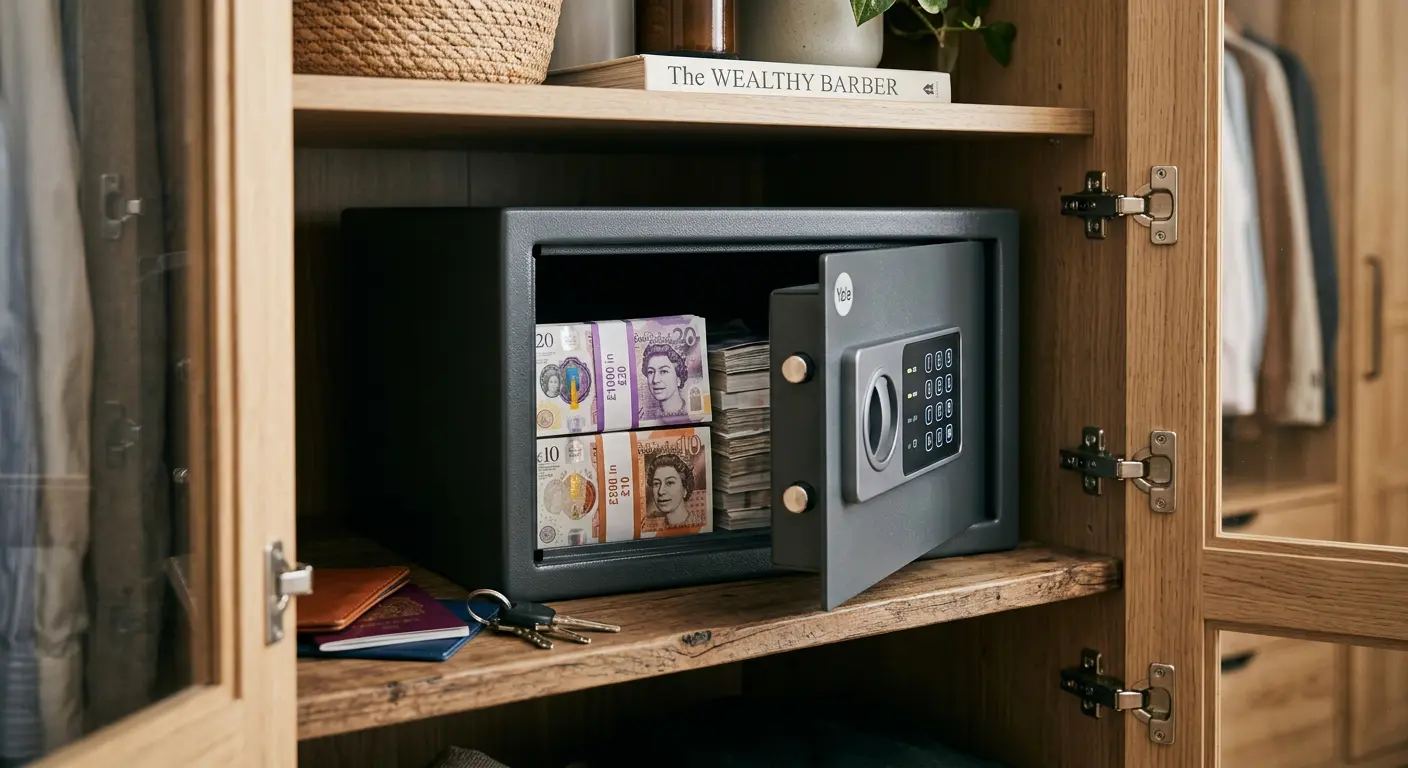
A certified safe is widely regarded as the most reliable option for home cash storage. Look for models carrying a Sold Secure or EN 1143-1 rating — these have been independently tested for resistance to physical attack. Many also carry a fire rating (typically 30–60 minutes at 1,000°C), which matters because unprotected paper banknotes can be destroyed at relatively moderate temperatures.
Installation is as important as the safe itself. A safe that isn't bolted to a floor or wall can simply be carried away — an obvious point, but one that's frequently overlooked. Any decent installation anchors the unit to the building fabric, ideally concealed beneath a floor covering or within a built-in cupboard.
Concealed locations around the home
For smaller sums, concealment within the home can supplement — though not replace — a proper safe. Effective hiding spots share a few characteristics: they're not immediately obvious to a stranger in a hurry, they're not near valuables that might attract a search, and they protect against moisture as well as discovery.
 Inside a hollowed-out book placed on a packed, unremarkable shelf — effective against a quick search
- Inside sealed containers within food cupboards (flour tins, coffee jars) — low probability of discovery
- Behind wall-mounted fixtures or inside false electrical outlet boxes — requires installation but highly effective
- In a fireproof document pouch kept within a larger locked cabinet — dual protection against theft and fire
- Under floorboards, accessed via a concealed hatch — effective but requires planning and maintenance
Avoid the most commonly searched spots: under mattresses, inside sock drawers, at the back of wardrobe shelves, and behind picture frames. Professional burglars move quickly and know exactly where to look first.
Insurance: What Your Policy Actually Covers
This is where many homeowners get a genuinely unpleasant surprise. Standard home contents insurance policies include a specific sub-limit on cash — typically set at £500. Some policies extend to £1,000, but few standard policies cover more than that without a specific endorsement or declaration.
What this means in practice: if you keep £3,000 in cash at home and you're burgled, your insurer will likely pay out only £500 — even if your total claim is otherwise well within your policy limits.
To increase your cash cover, you typically need to notify your insurer explicitly, describe your storage arrangements in detail, and pay an additional premium. A certified, anchored safe will generally unlock significantly higher cash limits.
The Bank of England replacement service: If cash notes are damaged in a fire or flood but remain identifiable (even partially), the Bank of England's mutilated banknote service may be able to replace them. It's not a guaranteed route, but it's worth knowing about if the worst happens.
Cash at Home vs Bank: How They Compare
| Factor | Cash at Home | Money in the Bank |
|---|---|---|
| Access during outage | ✓ Immediate, no tech needed | ✗ May be inaccessible |
| Interest earnings | ✗ Earns nothing | ✓ 4–5% AER typical |
| FSCS protection | ✗ None — total loss risk | ✓ Up to £85,000 |
| Risk of theft/fire | ✗ Real risk without a safe | ✓ Negligible |
| Privacy | ✓ Complete — no record | ✗ All transactions logged |
| Inflation erosion | ✗ Full exposure | ✓ Interest partially offsets |
| Insurance sub-limit | ✗ Typically £500–£1,000 | ✓ Not applicable |
| Everyday spending | ✓ Universal | ✓ Fast via card/app |
 Free Home Cash Safety Checklist
A practical checklist covering storage, insurance, and record-keeping — tailored for UK households. Enter your details below to access it.
 We respect your privacy. Your details are never shared or sold. Sent securely by SmartVault UK.
 You're all set!
Check your inbox — the checklist will arrive within a few minutes.
Common Questions UK Households Ask

HMRC does not monitor cash held at home, and there is no requirement to declare it. What can draw attention is a visible mismatch between your declared income and the lifestyle or assets you maintain over time. Keeping straightforward records of where any significant cash sum originated is good practice regardless and costs nothing.
Unprotected banknotes will be destroyed in any significant house fire. Your home insurance will typically only compensate up to its cash sub-limit — commonly £500. A fire-rated safe protects the notes themselves, and also makes it more likely that your insurer will offer enhanced cover. The Bank of England's mutilated banknote replacement service may be able to help if partially damaged notes remain identifiable.
Almost certainly, for any deposit that seems unusual for your account. UK banks are required by anti-money laundering regulations to ask about large or out-of-character cash deposits. This is not accusatory — it's a compliance process. Simply be ready to explain the origin of the funds: savings, a cash gift, proceeds from a private sale, or a family bequest.
No. There is no legal cap on the amount of cash you may keep in your home in the UK. The practical limits come from two directions: your home insurance cash sub-limit (typically £500–£1,000) and the security risks of holding large sums without adequate protection.
Most practical guidance points to £200–£500 for a single person, or £300–£1,000 for a household. This covers a few days of essential spending in a scenario where cards are unusable. Your specific figure should reflect your location, ATM access, and whether you regularly use cash-only local businesses.
Declaring higher cash reserves to your insurer will typically result in a small premium increase, but this is usually modest. What's more significant is that failing to declare a large cash holding — and then making a claim — can result in the insurer disputing or rejecting it entirely. Transparency with your insurer is always the more secure approach.
Our Verdict
Keeping a modest cash reserve at home is a sensible, legal, and responsible element of financial preparedness for UK households in 2025. The questions that actually matter aren't about legality — they're about how much, stored how, and whether your insurance reflects what you're holding.
A realistic emergency fund — broadly one to four weeks of essential spending — makes sense for most people. Anything beyond that begins to carry meaningful opportunity cost and security risk, and is typically better placed in an easy-access savings account where it earns interest and remains FSCS protected.
If you do store cash at home: invest in a certified safe, bolt it down, and call your insurer to verify — and if necessary, increase — your cash cover. Those three steps address the vast majority of the real risk.


 Emily Chambers — Personal Finance Writer
Emily covers household money management, savings strategy, and consumer financial rights for SmartVault UK. She has over six years of experience writing about UK personal finance and holds a Diploma in Financial Planning (LIBF). She has contributed to consumer finance publications covering savings, budgeting, and home insurance for UK households.
 How This Content Was Prepared
This article draws on publicly available UK financial guidance, home insurance policy terms, Bank of England consumer guidance on mutilated banknotes, and general consumer finance principles. It is intended for informational purposes only and does not constitute regulated financial advice. Always consult a qualified, FCA-regulated adviser for decisions specific to your situation.
 Related Guidance

 Reader Discussion
Have a question or experience to share? We'd love to hear from you.
Email: hello@smartvaultuk.co.uk
Phone: 020 7946 0123
Address: 47 King's Road, Bristol, BS1 4EF, United Kingdom
 Privacy Policy
 Accessibility